
- Largest Gap Ever Recorded in Sentiment Between Nation and New York
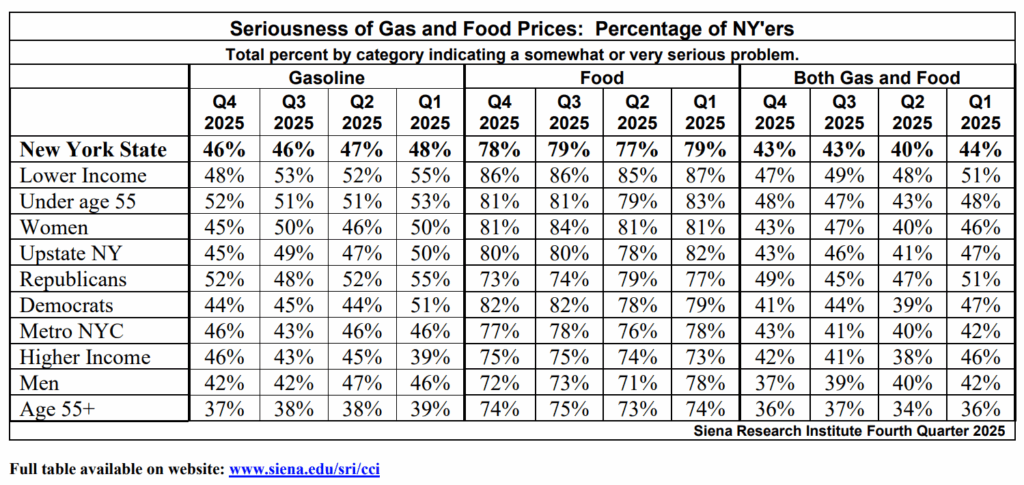
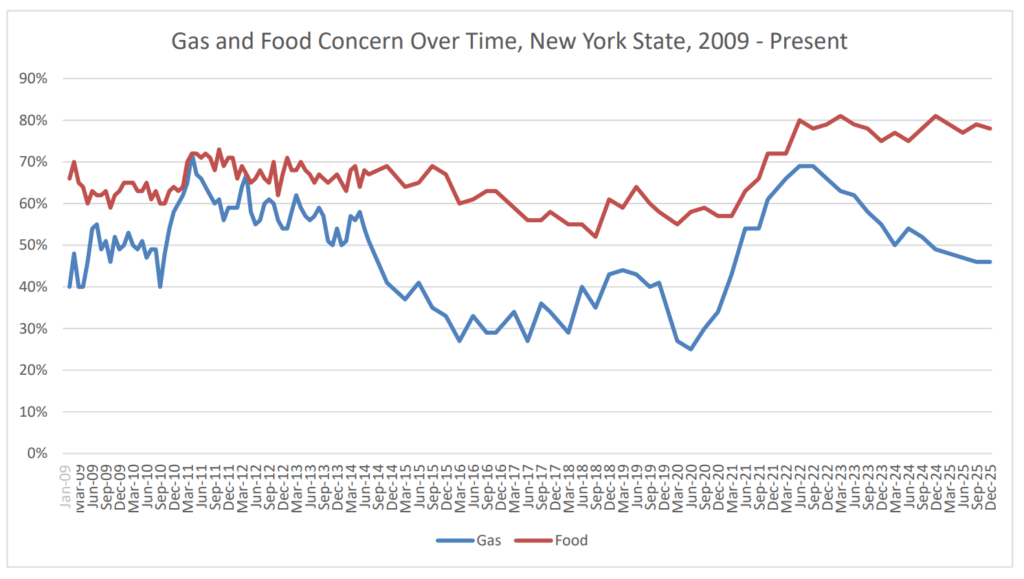
- Buying Plans Remain Robust Despite Economic Concerns; 78% of New Yorkers Say Food Prices Seriously Impact Finances, 46% Say the Same for Gas
Press Release Summary Trends Buying Plans Gas and Food
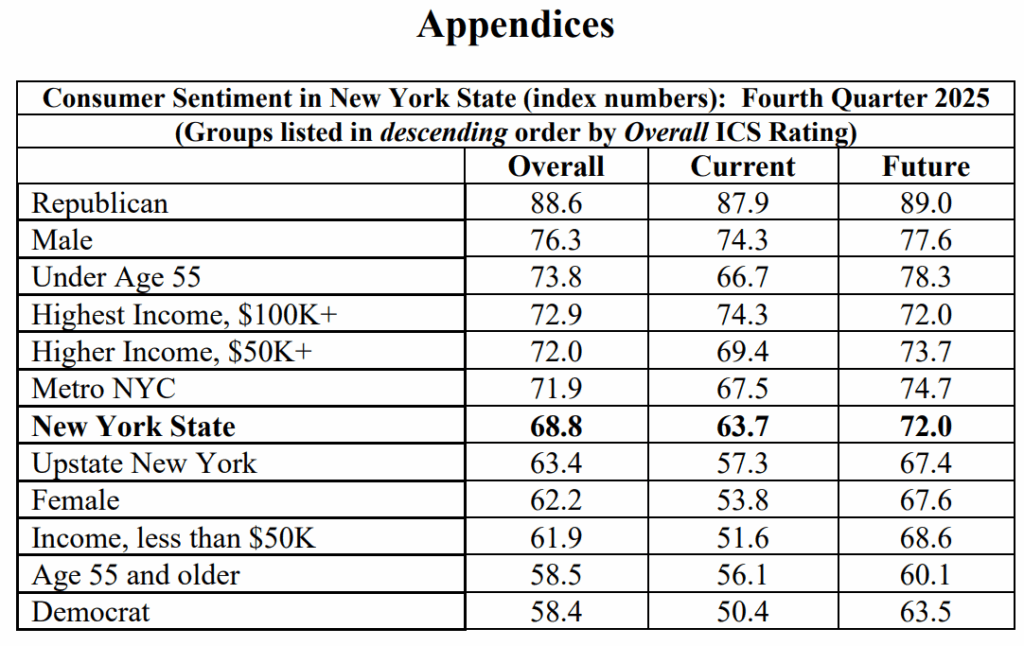
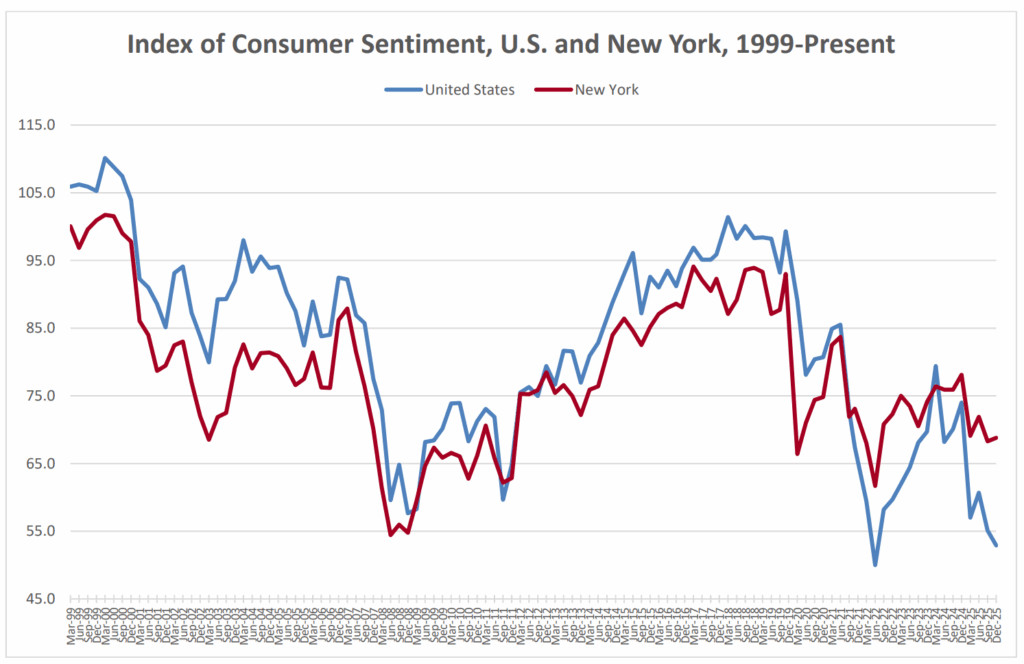
Loudonville, NY – The New York State Index of Consumer Sentiment now stands at 68.8 up 0.5 points from the last measurement in the third quarter of 2025 according to the latest poll by the Siena Research Institute (SRI). New York’s overall Index of Consumer Sentiment is 15.9 points above the national* index of 52.9 following a 2.2-point national decrease. New York’s current index fell 4.1 points to 63.7 and New York’s measure of future expectations increased 3.4 points from 68.6 last quarter to 72.0 today. The Index of Consumer Sentiment remains higher in New York than across the nation. For the fourth consecutive quarter, the overall index is below the breakeven point of balanced optimism and pessimism.

“Consumer sentiment has seen a sustained decline since the 2024 election, with the national index falling 21.1 points and New York dropping 9.3 points,” according to Travis Brodbeck, SRI’s Associate Director of Data Management. “Over the last year, current ratings and future expectations have both fallen by more than 20 points nationally, far outpacing the single-digit declines in New York. While the national index was typically higher than New York’s before the pandemic, we are now seeing the largest gap on record in the opposite direction, with the nation trailing New York by 15.9 points. In other words, the breakeven point between optimism and pessimism in New York is within reach, but nationally there is much more ground to make up.”
Buying plans in the third quarter are mostly negative with the exception of homes. Since the previous quarter’s measurement, buying plans for cars or trucks decreased 0.6% (from 19.6%) to 19.0% and major home improvement plans dropped to 22.3% (from 23.3%). The two largest decreases in buying plans were in furniture, falling 5.2% to 24.5%, and consumer electronics, dropping to 41.1% (from 44.2%). Plans to buy a home rose 2.2 percentage points to 10.9%, bringing them back to June 2025 levels.
“While consumer sentiment is depressed relative to a year ago, spending intentions are down but remain resilient,” Brodbeck said. “Nearly one in five New Yorkers say they have plans to purchase a vehicle, furniture, or a major home improvement, four in ten intend to buy consumer electronics, and just under 11 percent say they looking to buy a home. These robust buying plans highlight a disconnect: consumers remain pessimistic about the broader economy, yet they continue to spend.”
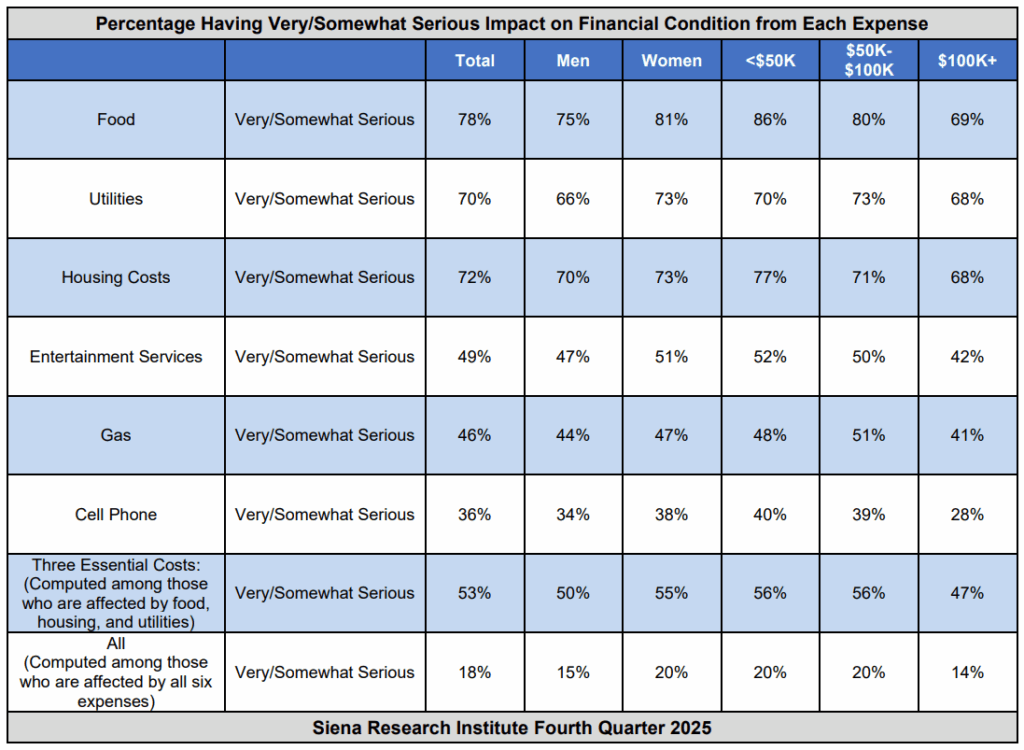
Of the monthly living expenses that New Yorkers face, at least 7 in 10 New Yorkers say that food, housing, and utility costs are having a very or somewhat serious impact on their financial condition. Compared to the previous quarter, housing costs rose to 72 percent from 71 percent, utilities are unchanged at 72 percent, and food costs fell slightly to 78 percent (down from 79% last quarter). Forty-nine percent say streaming and entertainment services are a serious financial strain (down from 50% last quarter). Forty-six percent (unchanged from last quarter and the lowest since March 2021) of all New Yorkers say that current gasoline prices are having a very serious or somewhat serious impact on their financial condition. The seriousness of cell phone costs declined to 36 percent (down from 38%). Fifty-three percent of New Yorkers say they are seriously impacted by all three essentials—housing, utilities, and food. Eighteen percent of residents report that all six key monthly expenses—food, gas, housing, utilities, entertainment, and cell phones—are weighing heavily on their finances.
This Siena Poll was conducted November 17 – 21, 2025, among 839 New York State Residents. Of the 839 respondents, 408 were contacted through a dual frame (landline and cell phone) mode (128 completed via text to web) and 431 respondents were drawn from a proprietary online panel (Cint). Telephone calls were conducted in English and respondent sampling was initiated by asking for the youngest person in the household. Telephone sampling was conducted via a stratified dual frame probability sample of landline and cell phone telephone numbers weighted to reflect known population patterns. The landline telephone sample was obtained from ASDE and the cell phone sample was obtained from Marketing Systems Group (MSG). Interviews conducted online are excluded from the sample and final analysis if they fail any data quality attention check question. Duplicate responses are identified by their response ID and removed from the sample. Three questions were asked of online respondents, including a honey-pot question to catch bots and two questions that ask respondents to follow explicit directions. The proprietary panel also incorporates measures that safeguard against automated bot attacks, deduplication issues, fraudulent VPN usage, and suspicious IP addresses. Data from collection modes was weighted to balance sample demographics to match estimates for New York State’s population using data from the Census Bureau’s 2023 U.S. American Community Survey (ACS), on age, region, race/ethnicity, and gender to ensure representativeness. The sample was also weighted to match current patterns of party registration using data from the New York State Board of Elections. It has an overall margin of error of +/- 3.8 percentage points including the design effects resulting from weighting. Sampling error is only one of many potential sources of error and there may be other unmeasured error in this or any other public opinion poll. The Siena Research Institute, directed by Donald Levy, Ph.D., conducts political, economic, social, and cultural research primarily in NYS. SRI, an independent, non-partisan research institute, subscribes to the American Association of Public Opinion Research Code of Professional Ethics and Practices. For survey cross-tabs: www.Siena.edu/SRI/.