

- Future Confidence in New York Reaches Lowest Measurement Since October 2013
- Concern Over Gas Prices Reaches 51%, Food 79%; Buying Plans Mostly Unchanged
Press Release Summary Trends Buying Plans Gas and Food
Loudonville, NY – The New York State Index of Consumer Sentiment now stands at 65.6 down 3.2 points from the last measurement in the fourth quarter of 2025 according to the latest poll by the Siena Research Institute (SRI). New York’s overall Index of Consumer Sentiment is 12.3 points above the national* index of 53.3 following a 0.4-point national increase. New York’s current index fell 0.4 points to 63.3 and New York’s measure of future expectations decreased 4.8 points from 72.0 last quarter to 67.2 today. The Index of Consumer Sentiment remains higher in New York than across the nation. For the fifth consecutive quarter, the overall index is below the breakeven point of balanced optimism and pessimism.

“While the national Index of Consumer Sentiment rose slightly, mostly driven by the sharp increase in the current sentiment, New York’s overall Index dropped by 3.2 points,” according to Travis Brodbeck, SRI’s Associate Director of Data Management. “In New York, the drop in the Index is driven by the steep decline in future confidence, the Index of Consumer Expectations, which is at its lowest point since October of 2013. Both in New York and nationally, there was at least a 2.9-point drop in future confidence. In New York, confidence in the future dropped across all demographic groups with the most dramatic decline among Republicans dropping 14.1 points to 74.9.”
Buying plans in the first quarter are mostly negative except for furniture and consumer electronics. The largest decrease in buying plans was in intention of buying a home, falling 1.0% to 9.9%. Since the previous quarter’s measurement, buying plans for cars or trucks decreased 0.7% (from 19.0%) to 18.3% and major home improvement plans dropped to 22.1% (from 22.3%). Intent to purchase consumer electronics increased to 41.6% (from 41.1%). Plans to purchase furniture rose 5.6 percentage points to 30.1%, bringing them back to 2025 levels (30.2%).
“Intentions to buy any of the six big ticket items is relatively unchanged, Brodbeck said. “Even the movement that we recorded in intentions to purchase furniture brings buying plans back to levels previously recorded. New Yorkers are not pulling back on their spending, but they also are not increasing their spending. Residents are staying the course and spending more cautiously.”
Of the monthly living expenses that New Yorkers face, a majority of New Yorkers (57%) say that food, housing, and utility costs are having a very or somewhat serious impact on their financial condition. Compared to the previous quarter, the impact of housing costs for New Yorkers remain unchanged at 72 percent very or somewhat serious, the impact of utilities is up five percentage points at 75 percent, and the impact of food costs rose from 78 percent to 79 percent. Fifty-one percent say streaming and entertainment services are a serious financial strain (up from 49% last quarter). Fifty-one percent of all New Yorkers say that current gasoline prices are having a very serious or somewhat serious impact on their financial condition, an increase of five percentage points from last quarter. The seriousness of cell phone costs declined to 33 percent (down from 36%). Nineteen percent of residents (up from 18% last quarter) report that all six key monthly expenses—food, gas, housing, utilities, entertainment, and cell phones—are weighing heavily on their finances.
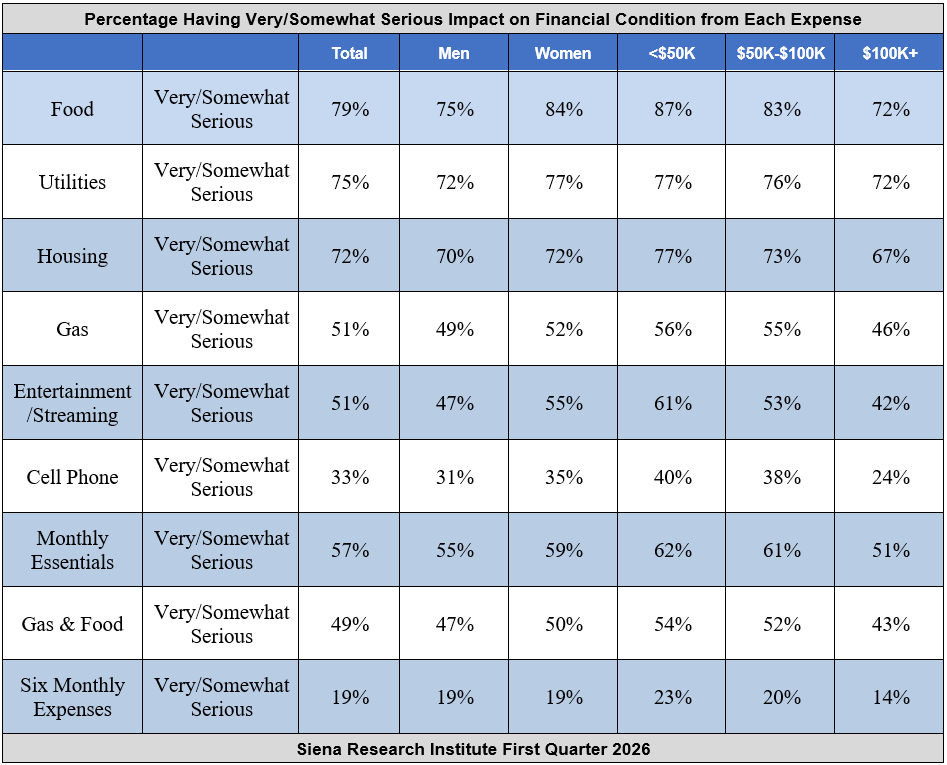
“Gas prices are up and so is the number of New Yorkers who say that gas prices are having a serious impact on their financial condition”, Brodbeck said. “To ensure we are capturing the evolving situation impacting the budgets of New Yorkers, we took two additional measurements on the seriousness of gas prices. First, we conducted an online poll of 389 state residents in late March and found that 70% say that gas prices are seriously impacting their financial condition. In our survey of New York’s registered voters released earlier this week, 64% of voters said that gas prices are having a somewhat or very serious impact on their financial condition. The trend from these three measurements shows that as geopolitical events unfold, New Yorkers are saying that they feel the pain at the pump.”
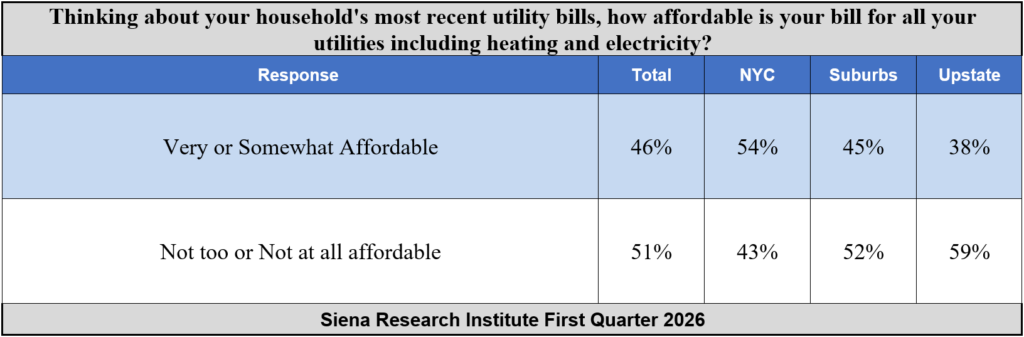
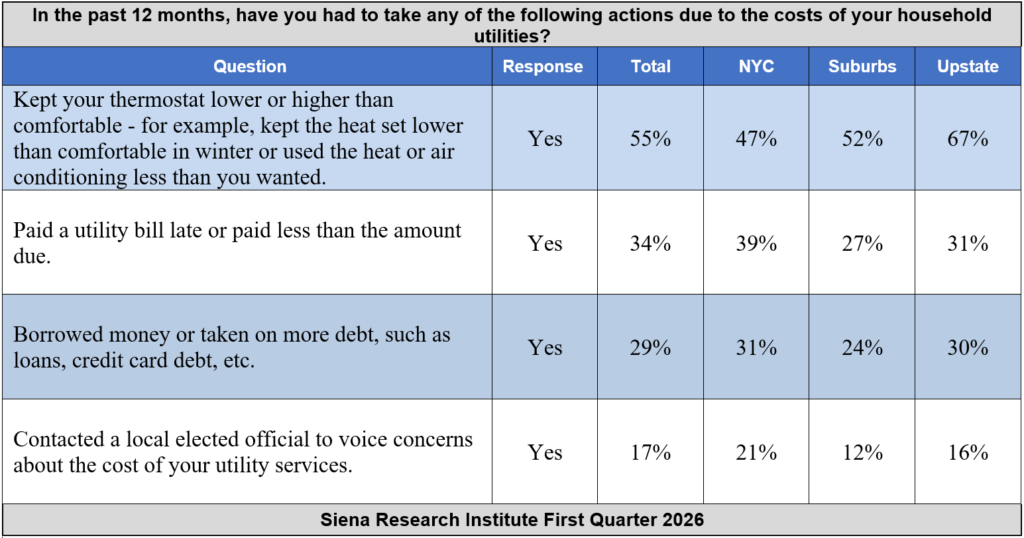
This quarter’s survey included additional questions on home utilities. Fifty-one percent of New Yorkers say that their utility bills including heating and electricity are unaffordable with 18 percent saying they are not at all affordable and 33% are not too affordable. This is contrasted by the 46 percent of New Yorkers who say that their utility bills are affordable with 10 percent saying their bills are very affordable and 36 percent who say their bills are somewhat affordable. In response to the cost of their household utilities, half of New Yorkers (55 percent) say they have kept their thermostat at a lower or higher temperature than would be comfortable for them. A third of New Yorkers (34%) say they have paid a utility bill late or paid only a partial amount, 29 percent have borrowed money or taken on debt, and 17 percent contacted a local official to voice concerns about the cost of their utilities.
“Three-quarters of New Yorkers say that their utility bills are having a serious impact on their financial condition and 51 percent say their utility bills are unaffordable. However, the pain is not shared equally across New York. Fifty-nine percent of upstate New York residents say that their utilities are unaffordable while 54 percent of New York City residents say that their utilities are affordable”, Brodbeck said. “In response to these financial pressures, many NY’ers are adjusting their thermostats, and a third of utility paying residents are paying bills late, 3 in 10 are taking on more debt, and nearly 1 in 5 have contacted their elected officials.”
###
This Siena University Poll was conducted March 3 – 14, 2026, among 810 New York State Residents. Of the 810 respondents, 428 were contacted through a dual frame (landline and cell phone) mode (158 completed via text to web) and 382 respondents were drawn from a proprietary online panel (Cint). Telephone calls were conducted in English and respondent sampling was initiated by asking for the youngest person in the household. Telephone sampling was conducted via a stratified dual frame probability sample of landline and cell phone telephone numbers weighted to reflect known population patterns. The landline telephone sample and the cell phone sample was obtained from Marketing Systems Group (MSG). Interviews conducted online are excluded from the sample and final analysis if they fail any data quality attention check question. Duplicate responses are identified by their response ID and removed from the sample. Three questions were asked of online respondents, including a honey-pot question to catch bots and two questions that ask respondents to follow explicit directions. The proprietary panel also incorporates measures that safeguard against automated bot attacks, deduplication issues, fraudulent VPN usage, and suspicious IP addresses. Coding of open-ended responses was done by a single human coder. Data from collection modes was weighted to balance sample demographics to match estimates for New York State’s population using data from the Census Bureau’s 2023 U.S. American Community Survey (ACS), on age, region, race/ethnicity, and gender to ensure representativeness. The sample was also weighted to match current patterns of party registration using data from the New York State Board of Elections. It has an overall margin of error of +/- 3.6 percentage points including the design effects resulting from weighting. Sampling error is only one of many potential sources of error and there may be other unmeasured error in this or any other public opinion poll. The Siena Research Institute (SRI) powered by ReconMR is directed by Donald Levy, Ph.D.. SRI conducts political, economic, social, and cultural research primarily in NYS. SRI, an independent, non-partisan research institute, subscribes to the American Association of Public Opinion Research Code of Professional Ethics and Practices. For survey cross-tabs: www.Siena.edu/SRI/.