

- 67% of NY’ers use AI Chatbots, 44% Use AI At Least Weekly; 48% Say Their Usage Increased Since Last Year
- Of AI Users: 56% of Say They Double-Check AI Results; 4 in 10 Use AI for Personal Reasons; 20% Pay for an AI Subscription; ChatGPT Use Leads Gemini, Copilot, and Other Commercial Models
- 87% of NY’ers Have Frequently Seen AI-Generated Content in Last 30 Days; Trust in Traditional Search Engines Exceeds Trust in AI
Loudonville, NY – Forty-three percent of New York State residents say the disadvantages of artificial intelligence (AI) are too great while just over a third (37%) say the advantages outweigh the disadvantages, according to a new Siena Poll of New York State residents released today. However, nearly one in five (19%) say they don’t know if the advantages of AI outweigh the disadvantages. AI chatbots are used by two-thirds (67%) of New Yorkers, while 32 percent say they never have used an AI chatbot. Forty-four percent report using the technology at least weekly, with 21 percent who say they use AI chatbots daily, and 23 percent who use the tools at least once a week. Compared to last year, 48 percent of residents say they are using AI tools more, 39 percent say they are using the tools about the same, and 8 percent say that their AI use has decreased.
Of the New Yorkers who use AI chatbots, 41 percent say their primary use of AI is mostly for personal reasons, 24 percent use AI mostly for professional reasons, and nearly a third, 32 percent, say they use AI equally for both personal and professional reasons. Half of users (56%) say they often double-check the information or results provided by an AI tool ‘always’ or ‘most of the time’. One in five (20%) AI chatbot users say they currently pay for a subscription to an AI chatbot. Of New Yorkers who use AI chatbots at least weekly, nearly three in ten (28%) pay for a premium subscription compared to only 5 percent of those who infrequently use chatbots. Across both frequent and infrequent AI chatbot users, the tool most often used is ChatGPT followed by Gemini, and Copilot.
Seven in ten New Yorkers say they are very or somewhat familiar with AI chatbots. Nearly nine in ten residents, 92 percent, say they have seen content in the last 30 days that appeared to be generated by AI. When it comes to trusting the information provided by AI chatbots, New Yorkers have mixed feelings. While 35 percent of New Yorkers say they trust the results from a traditional search engine more than information provided by an AI chatbot, 8 percent trust AI results more, 28 percent trust search engines and AI output equally, and 23 percent trust neither source.
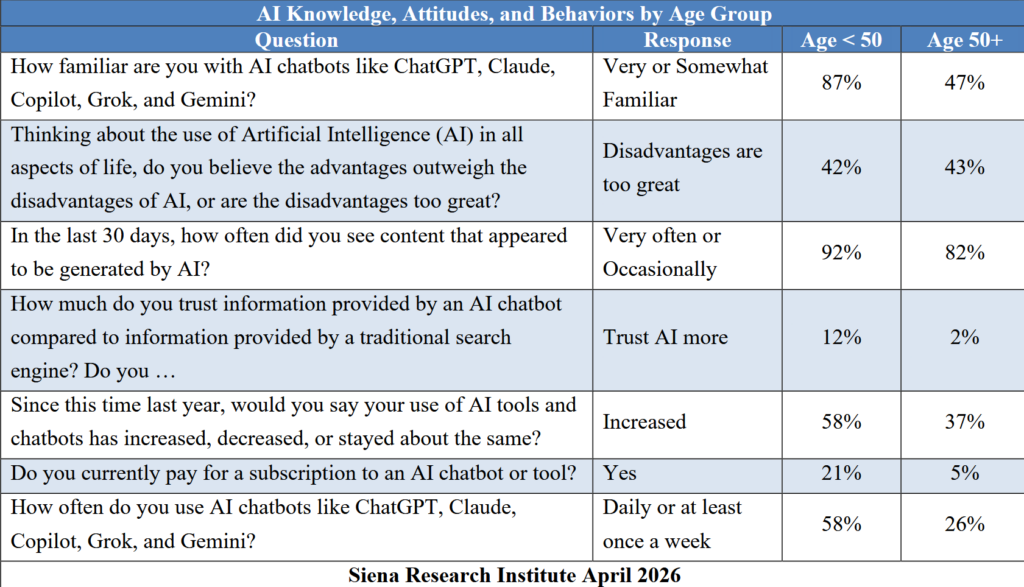
Familiarity with AI chatbots varies greatly by age where 56 percent of those under 35 years say they are very familiar compared with only 6 percent of those 65 years and older. Despite the differences in familiarity, concern about the technology is similar across age groups where four in ten of those under age 50 and over age 50 think the disadvantages of technology outweigh the advantages. Still, the information provided by AI is trusted over that of search engines by a greater share of residents under 50 (12%) than those over 50 (2%), while residents say they trust the results of neither AI nor search engines at nearly double the rate among those over 50 (32%) than those under 50 (16%). Paying for an AI subscription and AI usage is much more common with those under 50 years of age than those over the age of 50.
“Four years after ChatGPT was released to the public, AI is creeping into everyday life, whether you use a dedicated chatbot app or website, or use AI features embedded in other spaces. Almost every New Yorker, regardless of background, encounters AI-generated content,” Associate Director of Data Management Travis Brodbeck said. “Like various forms of emerging technology, we see gaps in behaviors and attitudes between the youngest and oldest New Yorkers. These age-related differences risk creating a new element to the ‘digital divide’ where the ability to discern AI content and use AI tools is a new skill required in the digital age.”
Appendix

# # #
This Siena University Poll was conducted March 3 – 14, 2026, among 810 New York State Residents. Of the 810 respondents, 428 were contacted through a dual frame (landline and cell phone) mode (158 completed via text to web) and 382 respondents were drawn from a proprietary online panel (Cint). Telephone calls were conducted in English and respondent sampling was initiated by asking for the youngest person in the household. Telephone sampling was conducted via a stratified dual frame probability sample of landline and cell phone telephone numbers weighted to reflect known population patterns. The landline telephone sample and the cell phone sample was obtained from Marketing Systems Group (MSG). Interviews conducted online are excluded from the sample and final analysis if they fail any data quality attention check question. Duplicate responses are identified by their response ID and removed from the sample. Three questions were asked of online respondents, including a honey-pot question to catch bots and two questions that ask respondents to follow explicit directions. The proprietary panel also incorporates measures that safeguard against automated bot attacks, deduplication issues, fraudulent VPN usage, and suspicious IP addresses. Coding of open-ended responses was done by a single human coder. Data from collection modes was weighted to balance sample demographics to match estimates for New York State’s population using data from the Census Bureau’s 2023 U.S. American Community Survey (ACS), on age, region, race/ethnicity, and gender to ensure representativeness. The sample was also weighted to match current patterns of party registration using data from the New York State Board of Elections. It has an overall margin of error of +/- 3.6 percentage points including the design effects resulting from weighting. Sampling error is only one of many potential sources of error and there may be other unmeasured error in this or any other public opinion poll. The Siena Research Institute (SRI) powered by ReconMR is directed by Donald Levy, Ph.D.. SRI conducts political, economic, social, and cultural research primarily in NYS. SRI, an independent, non-partisan research institute, subscribes to the American Association of Public Opinion Research Code of Professional Ethics and Practices. For survey cross-tabs: sri.siena.edu