

- Majorities Remain Opposed to Transgender Athletes Competing with Those Who Share Their Gender Identity – But 20% Say They ‘Don’t Know’ If Prompted
- 62% Have Used a Streaming Service to Watch Sporting Events Over the Past Year; 52% Are Not Concerned About Affording to Watch Games Which May Only Be Available on Streaming
April 20, 2026 – A majority of Americans say athletes, coaches, and other figures in professional sports speaking out against what they believe are social injustices is good for sports, 54-26%, according to a new survey of United States residents released today by the Siena Research Institute (SRI) and St. Bonaventure University’s Jandoli School of Communication. A majority oppose transgender athletes competing with those of their gender identity, both when considering high school students and athletes at the college or professional level.
A growing majority of Americans, 62%, say they have used a streaming service, such as Hulu, Peacock, YouTube TV, Amazon Prime Video, or Fubo, to watch sporting events over the past year. A majority of 52-43% say they are not concerned that they will not be able to afford to see the games they want to watch when considering that specific streaming services may be the only way to see some games.
“Sports are important to the majority of Americans across every demographic group,” said Aaron Chimbel, dean of St. Bonaventure’s Jandoli School of Communication. “Americans talk sports regularly and care about how sports figures and leagues address social issues. Simply put, sports bring people together, even if they may view some issues differently.”
Forty-one percent say professional sports are doing ‘just enough’ (22%) or ‘an excellent job’ (19%) in addressing the issue of the gender pay gap, while 30% say they are not doing enough – a slight decline from 2025 when 37% said they were not doing enough. A solid half of Americans say that professional sports do more to overcome racial discrimination in America compared to 17% who say they perpetuate it (in 2025, 57% said that professional sports did more to overcome racial discrimination).
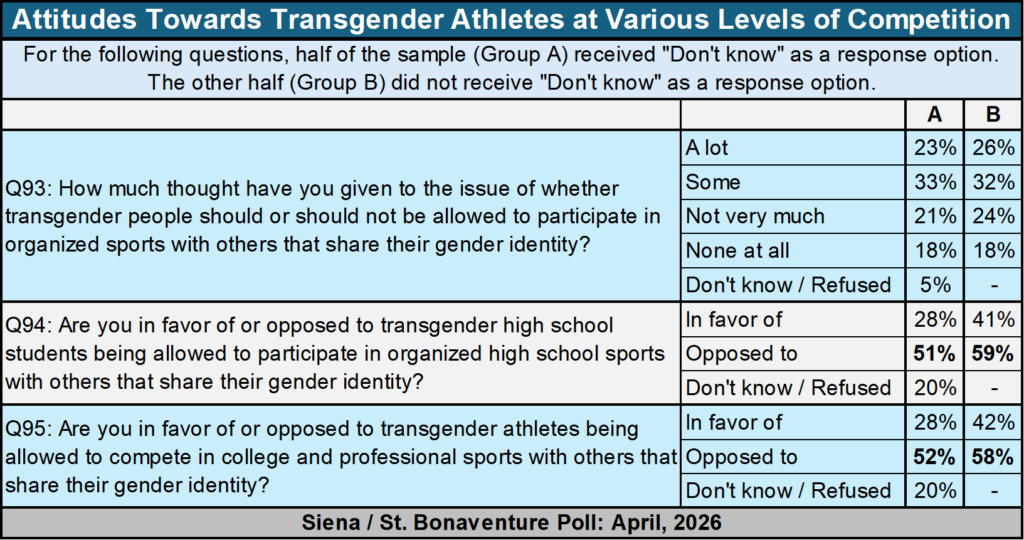
More than three-quarters of Americans say they have thought about the issue of whether transgender people should or should not be allowed to participate in organized sports with others that share their gender identity, consistent with findings from last year’s survey. Opposition to integration of transgender athletes has narrowed; at the high school level, opposition dropped from 65-35% in 2025 to 59-41% in 2026, and at the college or professional level, from 65-35% in 2025 to 58-42% in 2026.
“A significant portion of Americans, twenty percent, are willing to admit they simply don’t know whether or not transgender athletes should be allowed to compete with others that share their gender identity,” said Tess Zuchowski, SRI’s Polling Coordinator. “When we offer a ‘don’t know’ option, favorship for integration of transgender athletes in high school sports drops from 41% to 28%, but opposition also drops from 59% to 51%, just a one percentage point above the majority threshold. While most Americans have thought about the issue, many remain undecided.”
Twenty-one percent say they have used a league-specific streaming service such as the NBA League Pass, NHL.TV, MLB.TV or so on, to watch sport events over the past year, virtually unchanged from 2025. Thirty-nine percent say they have subscribed to a streaming service solely for the purpose of viewing a sporting event, compared to 60% who say they have not. A plurality of 44% agree with the statement, “I refuse to subscribe to a new service just to watch the events I used to enjoy as part of my regular cable television package” when asked to choose what most closely represents their view of streaming services which are required to watch certain sporting events.
For the fourth year in a row, Siena and St. Bonaventure have computed a fanship category for each respondent – nonfan, casual, involved, or avid. While ‘nonfans’ are the least likely to engage with sports on a regular basis, the most ‘avid’ fans report frequent participation in activities such as watching, following, and discussing sporting events. In this analysis, 24% are nonfans, 22% are casual fans, a plurality of 30% are involved fans and a quarter can be described as the most ‘avid’ fans – the latter of which has risen compared to previous years of the survey. Overall, 69% of Americans describe themselves as a sports fan. Majorities watch live sports on television or another platform (58%), watch or listen to sports news (54%), check the scores of live sporting events (53%), and talk about sports with friends or family (53%) at least once or twice a week.
Odds and Ends
- Football ranks as the favorite sport for a plurality of respondents, 38%, followed by basketball (16%), baseball (12%), soccer (7%) and hockey (4%).
- When asked to consider an executive order signed by U.S. President Trump which threatens to withhold federal funds from any educational institutions or athletic associations who allow transgender women to compete in women´s sporting competitions, 47-34% say that it is good for sports, while 19% say they don’t know.
- A majority of respondents continue to say that dedicated streaming services for individual sports leagues are good for sports, 52-24%, virtually unchanged from last year. Asked about a recent development, the streaming rights to the NFL Network being acquired by ESPN, a subsidiary of The Walt Disney Company, respondents are mixed with only 39-28% saying it is good for sports and 33% saying they don’t know.
- Just under a majority of respondents say that AI-powered predictions on the outcomes of sporting events being made available to fans during live games is bad for sports, 49-28%, also unchanged from 2025.
Appendix
###
This American Sport Fanship Survey was conducted February 16 – 27, 2026 among 3,084 responses drawn from a proprietary online panel (Lucid/Cint) of United States Residents. Interviews conducted online are excluded from the sample and final analysis if they fail any data quality attention check question. Duplicate responses are identified by their response ID and removed from the sample. Three questions were asked of online respondents including a honey-pot question to catch bots and two questions ask the respondent to follow explicit directions. The proprietary panel also incorporates measures that “safeguard against automated bot attacks, deduplication issues, fraudulent VPN usage, and suspicious IP addresses.” Coding of open-ended responses was done by a single human coder. Data was statistically adjusted by age, region, race/ethnicity, education, and gender to ensure representativeness. The probability of being included in any given online survey sample is unknown, very difficult to ascertain, or simply zero (non-internet users). Further, the nature of use of the internet is not uniform within the population, so this limits one’s ability to calculate the likelihood of reaching a person through an online poll. Instead of a margin of error, we calculate the credibility interval. In this case, the poll has a credibility interval of plus or minus 1.9 percentage points. Statistical margins of error are not applicable to online polls. All sample surveys and polls may be subject to other sources of error, including, but not limited to coverage error and measurement error. Where figures do not sum to 100, this is due to the effects of rounding. The Siena Research Institute, directed by Donald Levy, Ph.D., conducts political, economic, social, and cultural research primarily in NYS. SRI, an independent, non-partisan research institute, subscribes to the American Association of Public Opinion Research Code of Professional Ethics and Practices. For more information or comments, please call Dr. Don Levy at 518-284-3551. St. Bonaventure University’s Jandoli School of Communication offers undergraduate and graduate degrees in sports media, journalism, communication and related fields. For more information or comments, please contact Aaron Chimbel at 716-375-2040.