

- 1 in 4 NY’ers Placed a Bet on a Sporting Event in the Last Year
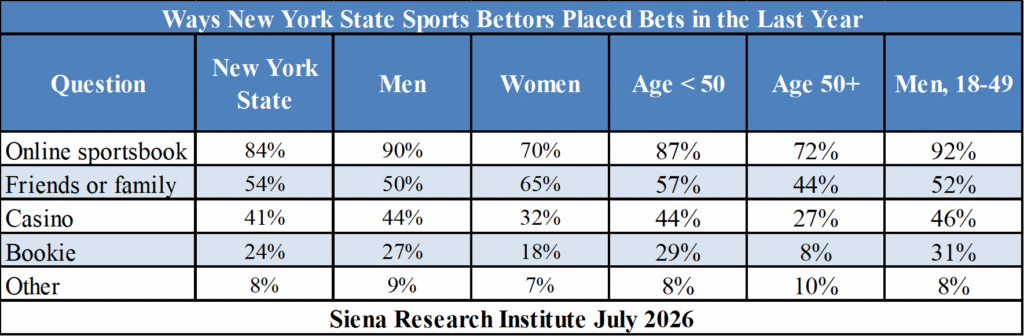
- Of Bettors: 84% Bet With Online Sportsbooks; 54% Bet With Friends or Family; 41% Bet With Casinos; 24% Bet With Bookies
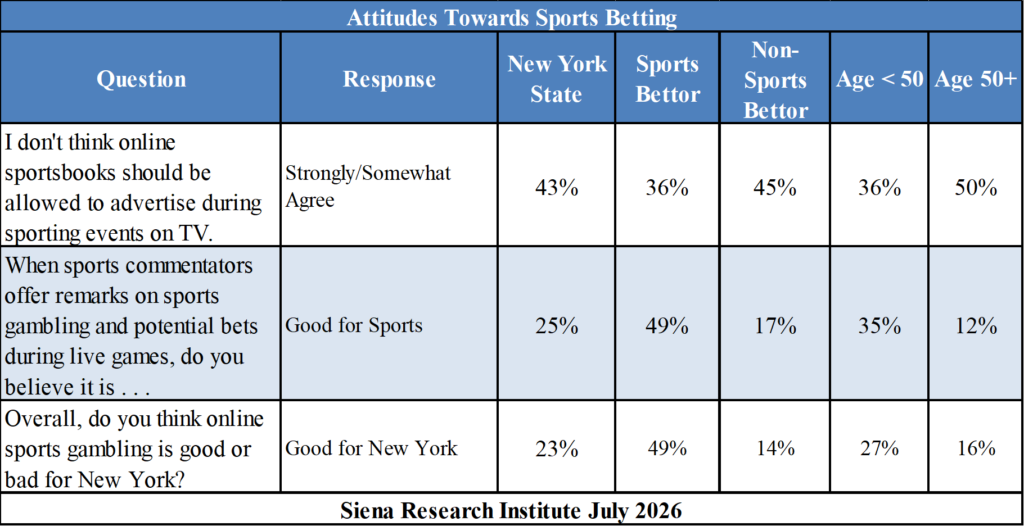
- NY’ers Split On Sportsbook Advertising During Televised Sporting Events; 52% Say Commentators Talking About Gambling During Live Games is Bad for Sports
Loudonville, NY – Thirty-nine percent of New York State residents say that online sports gambling is bad for New York, but 22 percent say online sports gambling is good for New York, while 31% are in the middle, according to a new Siena Poll of New York State residents released today. One in four New Yorkers (25%) say they have placed a bet of any size on the outcome of a sporting event in the last year. Of those who placed a bet in the last year, 84% placed bets with online sportsbooks, 54% placed bets with friends and family, 41% placed bets with casinos, and 24% placed bets with bookies.
New Yorkers are closely divided on whether online sportsbooks should be permitted to advertise during televised sporting events, with 44% in favor and 43% opposed, and 14% said they don’t know. Half of New Yorkers (52%) say that commentators making remarks on potential bets and odds during live games is bad for sports, however nearly one in four (23%) say they don’t know.
Attitudes towards sports betting varies by age. Half of residents over 50 years old (50%) say that they agree that online sportsbooks should not be allowed to advertise during sporting events on TV, compared to only a third of those under 50 (36%). Nearly two-thirds (62%) of those over 50 say live commentary on sports betting during games is bad for sports whereas a plurality of residents (44%) under 50 say the betting commentary is bad for sports. Residents under 50 are mixed about the impact of online sports gambling on New York, with 27% who say it is good for New York, 33% who say it is bad for New York, and 34% who are in the middle. Of residents over 50, 46% say online sports gambling is bad for New York, 29% say it is in the middle, and one in seven (16%) say it is good for New York. “We are seeing a generational gap in those who participate in and support sports betting,” Associate Director of Data Management Travis Brodbeck said. “Not only are many young New Yorkers placing bets of their own, but they also view the issues surrounding sports betting through a different lens than older residents.”
There is a divide in how bettors and non-bettors perceive sports betting. When it comes to restricting online sportsbook advertisements during televised games, six in ten sports bettors (59%) disagree, while a plurality of non-bettors (45%) agree. Of sports bettors, almost half (49%), say commentary on live odds and bets during games is good for sports while 57% of non-bettors say it is bad for sports. Forty-nine percent of sports bettors say online sports gambling is good for New York compared to 14% of non-bettors who say online sports gambling is good for the state, with a plurality (45%) of non-bettors who say online sports betting is bad for New York.
“Attitudes towards sports betting varies greatly based on one’s participation with online sports betting,” Brodbeck said. “The majority of bettors are unbothered by TV ads for online sportsbooks and express minimal concern over live-game betting commentary. Ultimately, bettors view sports betting as a net positive for New York.”
In the last year, one in four New Yorkers placed a bet on a sporting event, but participation is higher among men compared to women (37% compared to 14%). Fifty-three percent of men aged 18-49 said they placed a bet on a sporting event in the last year. Among all New York sports bettors, the most common method of placing a bet was through online sportsbooks (84%) and 92% of male bettors aged 18-49 say they placed a bet with one of these companies in the last year.
“For the one in four New Yorkers who place bets on the outcome of a sporting event, online sportsbooks are used by nearly all bettors,” Brodbeck said. “Sports betting participation differs greatly by age and gender in New York. Young adults are more likely than older adults to place sports bets, and men are more likely than women to participate. Sports betting participation is especially concentrated among young men in New York.”
Appendix

# # #
This Siena University Poll was conducted July 1 – 8, 2026, among 814 New York State Residents. Of the 814 respondents, 365 were contacted through a dual frame (landline and cell phone) mode (52 completed via text to web) and 449 respondents were drawn from a proprietary online panel (Cint). Telephone calls were conducted in English and respondent sampling was initiated by asking for the youngest person in the household. Telephone sampling was conducted via a stratified dual frame probability sample of landline and cell phone telephone numbers weighted to reflect known population patterns. The landline telephone sample and the cell phone sample was obtained from Marketing Systems Group (MSG). Interviews conducted online are excluded from the sample and final analysis if they fail any data quality attention check question. Duplicate responses are identified by their response ID and removed from the sample. Three questions were asked of online respondents, including a honey-pot question to catch bots and two questions that ask respondents to follow explicit directions. The proprietary panel also incorporates measures that safeguard against automated bot attacks, deduplication issues, fraudulent VPN usage, and suspicious IP addresses. Coding of open-ended responses was done by a single human coder. Data from collection modes was weighted to balance sample demographics to match estimates for New York State’s population using data from the Census Bureau’s 2023 U.S. American Community Survey (ACS), on age, region, race/ethnicity, and gender to ensure representativeness. The sample was also weighted to match current patterns of party registration using data from the New York State Board of Elections. It has an overall margin of error of +/- 3.7 percentage points including the design effects resulting from weighting. Sampling error is only one of many potential sources of error and there may be other unmeasured error in this or any other public opinion poll. The Siena Research Institute (SRI) powered by ReconMR is directed by Donald Levy, Ph.D.. SRI conducts political, economic, social, and cultural research primarily in NYS. SRI, an independent, non-partisan research institute, subscribes to the American Association of Public Opinion Research Code of Professional Ethics and Practices. For survey cross-tabs: www.Siena.edu/SRI/.